


Sliced: Impact Q2 Updates

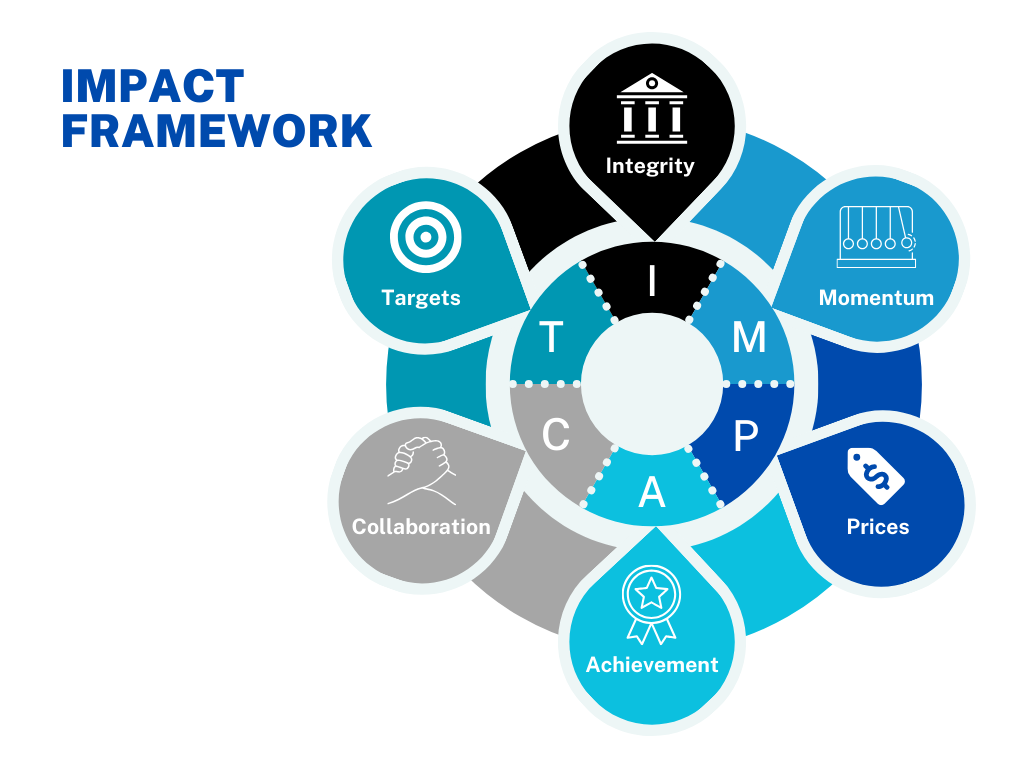
As we continue through 2024, our IMPACT framework, introduced at the close of 2023, remains a cornerstone of our strategic perspective. This acronym captures the crucial elements driving the evolution and acceleration of climate finance, carbon markets, and impact investing. Our framework has been instrumental in guiding our assessments and projections. It was first applied in our 2023 year-end review, utilized for our 2024 annual predictions, and implemented once more for our Q1 evaluation.
Now, we are leveraging it again to evaluate our progress and insights for the second quarter of 2024.
IMPACT stands for:
Integrity, Momentum, Prices, Achievement, Collaboration, and Targets.
I = INTEGRITY
As anticipated, advancements in market integrity have been progressing steadily.
The Integrity Council for the Voluntary Carbon Market (ICVCM) began both Program (Standards) and Category (Methodologies) level assessments in October 2023. Big updates from Q2 include an April announcement that several programs are now deemed CCP-eligible, including the American Carbon Registry (ACR), Climate Action Reserve (AR), and Gold Standard. Then in May, ICVCM confirmed Architecture for REDD+ Transactions TREES (ART) and Verra’s Verified Carbon Standard (VCS) as CCP-eligible too.
In June, ICVCM approved seven carbon crediting methodologies. These approvals mean that the high-integrity CCP label can now be applied to an estimated 27 million carbon credits generated by projects addressing potent greenhouse gases. These projects capture methane from landfill sites and destroy ozone-depleting foams and refrigerant gases from discarded equipment such as refrigerators and air conditioners.
On the demand side, the Voluntary Carbon Markets Integrity (VCMI) initiative announced that two companies, Bain & Company (USA) and Natura Cosmetics (Brazil), have achieved the Carbon Integrity Platinum Claim, the highest Carbon Integrity Claim. This claim requires the purchase and retirement of high-quality carbon credits equal to or exceeding 100% of a company’s remaining emissions.
Looking ahead to Q3 of 2024, we maintain our outlook that existing integrity initiatives will continue their momentum.
M = MOMENTUM
Our Q1 assessment highlighted the steps taken by the United States Securities and Exchange Commission (SEC) due to their approval of federal regulation that mandates publicly traded companies to disclose information related to climate change and how a warming planet poses risks to their business. Additionally, the proposed regulation mandates that some companies report their direct carbon dioxide emissions (except Scope 3 emissions).
Almost immediately, the rule faced legal challenges from oil and gas companies, the U.S. Chamber of Commerce, and several Republican-led states, who claimed the SEC lacked the authority to regulate climate change and argued the rules were unconstitutional and arbitrary. So, the SEC paused the climate disclosure rule to avoid regulatory uncertainty and allow the court to evaluate the litigation. Initially, the U.S. Court of Appeals for the Fifth Circuit granted an administrative stay, but that was later lifted when the cases moved to the Eighth Circuit. The SEC defends its authority to require important investor disclosures and maintains that the rule aligns with its historical practices. In this matter, there has been little progress throughout Q2.
A significant announcement from the White House provided momentum to the Voluntary Carbon Market (VCM). At the end of May, the Biden-Harris Administration unveiled new Principles for High-Integrity Voluntary Carbon Markets. These “Seven Principles for Responsible Participation” aim to address the need for action to help the VCM reach its potential. The White House hopes this initiative will generate the drive needed to push investments towards achieving the U.S.’s climate goals: reducing greenhouse gas emissions by half by 2030 and reaching net zero by 2050.
We anticipate continued momentum in Q3 regarding the clarity and introduction of regulations, enhanced disclosure requirements, and the advancement of carbon markets.
P = PRICES
Well, CCP-labeled credits are finally on the market! But it’s still too early to see how they will impact prices. Last week, a broker offering CCP credits noted that while initial offers started, no trades have occurred yet, making the CCP premium unclear. Many eligible projects are US-based, which already command higher prices. However, it is possible that the premium could be 25-50% over non-CCP credits. We are confident that by the time we release Q3 IMPACT assessment, there will be more clarity on how the CCP label impacts prices, or not.
American compliance markets have experienced allowance price increases in Q2. In the Regional Greenhouse Gas Initiative (RGGI), prices rose from $16 in our Q1 assessment to a current level of $21.86. Washington’s cap-and-invest program saw allowance prices reach $29.92, a significant 16.15% increase over prices in March. However, with Initiative 2117 on the November ballot, which could potentially repeal the cap-and-invest program this year, understandable market caution has emerged.
In Europe, compliance allowances from the European Union Emissions Trading System (EU ETS) are rebounding. During our Q1 assessment, European Union Allowance (EUA) prices were around €60 per allowance. Currently, EUAs are priced at €69.92 per allowance. Although this is still down 13.3% from the start of the year, prices are on the rise. EUAs are typically susceptible to geopolitical events but notably, they were hardly impacted by the recent European Parliament elections (more on this later).
From the voluntary side, CBL’s N-GEO voluntary market futures contracts, comprising nature-based offset projects from Verra, reached $1.53 per credit in May, up from $1.21 during our Q1 analysis. However, they sharply declined in June and are now trading at $1.01 per credit, a 10.99% increase from January.
In the VCM, there was a major carbon credit buying spree in Q2, led mainly by Microsoft. A sample of their recent deals includes an agreement to buy nearly 1 million nature-based carbon dioxide removal (CDR) credits from Anew Climate. They made another commitment to buy 1 million more over 10 years from Orsted’s BECCS project in Denmark. They contracted 36,000 CDR credits over three years from Canada’s Carbonity. They partnered with Carbon Streaming Corporation, Rubicon Carbon Capital, and Ponterra on the Azuero Reforestation Project in Panama which aims to restore 10,000 hectares of degraded forest and generate 3.24 million tonnes of carbon removal credits over 30 years. Finally, they co-founded the Symbiosis Coalition with Google, Meta, and Salesforce to procure 20 million high-quality, nature-based CDR credits by 2030. Talk about big tech money!
Our prediction for Q3 is that credit prices in the VCM will hover around their current level. At the same time, regulatory allowances will see increases in some markets (Europe, RGGI, and California) and decreases in other markets (Washington).
A = ACHIEVEMENT
The two-week Bonn Climate Change Conference recently concluded with some, but not many, achievements on Article 6, including carbon credit authorization, activity scope, and the international carbon market registry.
Discussions clarified some positions on Articles 6.2 and 6.4. A workshop was agreed upon to advance technical work before COP29 in November. The UN body responsible for the global carbon market will meet twice to finalize recommendations, and the Supervisory Body aims to complete a Sustainable Development Tool for environmental and social safeguards.
However, challenges remain as agreements failed to materialize on Article 6.2 (cooperative approach for government-to-government trading) and Article 6.4 (centralized global carbon mechanism). Disagreements persist on the role of registries and the necessary steps for buyers, sellers, and intermediaries to ensure environmental integrity. Delegates also presented concerns about transparency and human rights. In the end, new texts were published to streamline proposals, with hopes that COP29 in Azerbaijan will resolve these complex and politically charged issues. However, country negotiators opted to punt on deciding on whether to include emissions avoidance until 2028.
Despite the absence of finalized rules, countries continue with Article 6 agreements and projects. For example, South Korea recently announced support for four carbon projects in Vietnam, Ghana, and Uzbekistan, which could generate carbon credits.
UN meetings will continue throughout Q3 leading up to COP29 in Q4, with countries expected to remain engaged with Article 6.
C = COLLABORATION
We are halfway through 2024 and a handful of major elections are in the books, with mixed results for global collaboration on addressing climate change.
In Mexico, Claudia Sheinbaum was elected President. Her track record shows promise for Mexico’s approach towards climate change. As a climate scientist, she was one of the authors of the Intergovernmental Panel on Climate Change reports, highlighting the dangers of fossil fuels. Her past academic work also examined social impacts, such as a 2015 study on conflicts in Oaxaca following a wind project. She recommended national policies informed by local feedback. When she was the mayor of Mexico City, she electrified the public bus fleet, installed a large rooftop solar array on the main wholesale market, and expanded bike lanes, making several pandemic-era paths permanent. During her campaign, she advocated for expanding renewable energy infrastructure while also pledging to support the state-owned oil company, Petróleos Mexicanos, and maintain its state control. As the head of a major oil-producing country, President Sheinbaum’s path forward is not an easy one.
In Europe, the recent European Parliament elections saw a rise in far-right parties as they gained seats for the next five years. Fortunately, they did not gain enough to form a majority. Analysts believe that despite this shift, they won’t be able to dismantle the European Green Deal, the EU’s key climate legislation package, on their own. We will be keeping a close eye on what happens in Europe throughout Q3.
In India, Prime Minister Narendra Modi, leading the Bharatiya Janata Party (BJP), secured his third consecutive term after the party and its National Democratic Alliance (NDA) coalition won a parliamentary majority. Despite this victory, the BJP’s seat count fell to 240, below the 272 required for an outright majority. Modi will have to form a coalition to govern. Climate policy and collaboration in India are likely to continue down the same track it’s been on in recent years.
The final major election of the year is in the United States, where current President Joe Biden faces the convicted felon and former President Donald Trump. Another Trump Presidency almost certainly spells bad news for global collaboration while one more term of Biden should offer a continuation of his climate alliance approach.
Outside of national elections, collaboration was achieved among a variety of market stakeholders.
VCMI recently formed partnerships with climate-vulnerable countries to promote voluntary carbon markets and climate-related finance. This collaboration aims to support the Climate Prosperity Plans of CVF-V20 member countries, which focus on economic growth, development, and reducing greenhouse gas emissions. Key objectives include lowering the cost of capital for low-carbon projects, enhancing members’ capacities to participate in global carbon markets, developing carbon finance strategies, enabling fair carbon finance flows, and sharing knowledge to maximize the impact of carbon finance activities.
In a groundbreaking move, Gold Standard (GS) plans to collaborate with governments and subnational entities to certify the climate benefits of new policies and generate Paris Agreement-compatible carbon credits. GS introduced a pilot framework called “Policy Requirements and Procedures” which aims to financially incentivize the implementation of new climate policies, particularly in the energy and land use sectors. GS will certify and issue Verified Emission Reductions (VERs) based on certified greenhouse gas reductions or removals achieved through a policy-based program, similar to its current process for projects.
T = TARGETS
For corporates, the big shakeup related to targets was due to SBTi’s April announcement that companies might be able to use carbon credits to offset Scope 3 emissions. This statement caused division within SBTi and among market actors. To address concerns, SBTi plans to release a report in July on the effectiveness of carbon credits in corporate climate targets and will issue a discussion paper on potential changes to Scope 3 emissions targets. Additionally, SBTi appointed a five-member panel to oversee corporate climate goal validation services, as demand for target assessments continues to rise despite the controversy.
Setting targets is one thing. Putting in the effort to achieve them is another. In that sense, corporates are off track. In a recent paper analyzing the climate pledges of 115 large companies, only 69 had a net-zero target, and just 22% were committed to reducing emissions to a residual level and compensating with removals. Most companies do not adhere to the strict definition of net zero. Only 28 companies quantified their residual emissions. The paper concluded that corporate net-zero targets often lack substance, appearing more ambitious than their actual reduction and compensation commitments.
Ecosystem Marketplace released its 2024 State of the Voluntary Carbon Market. One of the key takeaways was that in 2023, the VCM saw a massive volume and value contraction for the second consecutive year since its 2021 peak. Reported transaction volumes declined by 56% year-on-year. The total reported transaction value fell to USD 723 million, down 61% from the previous year’s total of $1.9 billion. This is way off the target needed to mitigate climate change and protect the environment.
However, it was not all gloomy news in the Ecosystem Marketplace report. Although the total market value fell across all VCM credit categories, their traded volumes and average prices varied. Transaction volumes increased for projects in Energy Efficiency/Fuel Switching, Agriculture, and Household/Community Devices. North America saw a 15% increase in transaction volumes and prices in other Global North regions rose significantly, with average credit prices jumping 153% in Oceania and 78% in Europe.
We predict an upswing in market activity in the second half of 2024.
Well, that’s a wrap on our Q2 IMPACT assessment. We will be back again at the end of Q3 for our next one.
Disclaimer: Hi there, you are receiving this update from Gordian Knot Strategies based on your previous engagement with us in some capacity. If you wish to unsubscribe, please use the link below, and we promise you that your contact details will be permanently removed from our distribution list. Thanks!
Want to unsubscribe?
Click here.
Want to receive the Sliced weekly dispatch?
Click here.
If you want to see more of our content, check out our monthly newsletter, Virtus.
Click here.


2 Comments