


Sliced: IFNF Insights Brief No. 3 of 5: The Payors Problem – Why Verified Buyers Matter More Than Good Ideas

Listen to this Sliced essay on any of the streaming platforms below.

Written by: Sean Penrith
This is the third in a five-part Innovative Finance for National Forests (IFNF) Insights Brief Series produced by Gordian Knot Strategies, the U.S. Endowment for Forestry and Communities, and the U.S. Forest Service. Each brief distills a core lesson from the IFNF program, drawing on five cohorts of grantee experience to surface what it actually takes to move conservation finance from idea to execution. A new brief will be released each month via Sliced, so keep an eye out for the next in the series. For additional information on the overall program, please visit https://www.usendowment.org/ifnf/.
About the Innovative Finance for National Forests (IFNF) Program
The Innovative Finance for National Forests (IFNF) program (2020–2025) awarded $9.3 million across 38 projects to mobilize private capital for forest conservation. Grantees have collectively raised more than $108 million in blended finance. Gordian Knot Strategies developed the TRARO readiness framework and provided technical advisory services throughout the program.
The Challenge: Categories Are Not Commitments
Conservation finance projects routinely identify compelling ecological and community benefits. Watershed protection delivers measurable value to downstream utilities. Wildfire risk reduction protects communities and infrastructure. Forest restoration generates carbon sequestration and biodiversity gains. These benefits are real, quantifiable, and economically significant.
Yet across the IFNF applicant portfolio, a recurring pattern emerged. Projects with clear ecological value and sound technical approaches struggled to mobilize capital when they could not answer a fundamental question: Who will actually pay for this outcome, and on what basis?
Key Insight: TRARO analysis across Cohorts 2–4 revealed that the Payors element, defined as identification of willing and able buyers with documented purchasing intent, functioned as the single strongest predictor of capital mobilization and implementation success. In Cohort 3, first-round scoring showed applicants generally performed weakest on Payors, with a mean score of 5.6 out of 15 points (37% of maximum). While applicants improved these scores to 10.7 points by Round 2, a 91% gain and the largest single-element improvement, Payors remained the most discriminating factor between funded and unfunded projects, and between projects that later mobilized capital and those that stalled in design.
Success Drivers: What Strong Payor Readiness Looks Like
Projects that scored highly on the Payors element consistently exhibited three characteristics that distinguished them from peers relying on aspirational demand assumptions.
- Named Buyers, Not Buyer Categories: High-performing projects identified specific entities prepared to pay for defined outcomes. A corporate water stewardship initiative entered Cohort 2 with more than a dozen named Fortune 500 partners, including technology firms, consumer goods companies, and beverage producers, each with explicit sustainability commitments linked to watershed resilience investments. These were not hypothetical corporate interest categories. They were contractual relationships with documented payment histories and defined purchasing motivations tied to ESG reporting, water risk mitigation, and brand positioning. This level of specificity allowed the project to exceed its $3 million capital mobilization target and deliver more than $26 million in blended finance across multiple watersheds.
- Evidence of Willingness and Ability to Pay: Projects that succeeded provided concrete proof that identified payors were both willing and able to transact at the volumes and price points required to sustain the financial model. A wood vault carbon removal project in Cohort 3 achieved a TRARO score above 55 out of 60 by documenting specific corporate carbon buyers’ prior purchasing behavior, validated price tolerance ranges, and modeled leverage ratios (10–20x) based on actual voluntary carbon market transaction data. The project received a $250,000 pilot award and advanced rapidly toward commercial deployment because reviewers saw evidence of real market demand anchored in buyer track records, not generalized claims about market size.
- Clear Product-Payor Fit: Strong proposals articulated why payors would purchase the specific product offered, grounded in avoided costs, regulatory compliance, reputational value, or operational need. A utility-led water and carbon modeling initiative in Cohort 3 scored above 55 out of 60 by demonstrating that its utility customers had spent a decade funding water conservation programs and would pay for verified water supply certainty through long-term (10–20 year) energy service agreements. The value proposition was not that water mattered in the abstract. It was that this utility’s ratepayers and regulators required water security, and the proposed product delivered it in a form the utility could price, contract, and defend.
Common Pitfalls: How Weak Payors Undermine Otherwise Strong Projects
- Assuming Benefits Equal Buyers: Many proposals documented substantial public benefits, such as cleaner water, reduced wildfire risk, biodiversity gains, and assumed these benefits would naturally generate paying customers. A recreation-focused project identified significant economic value from outdoor visitation but could not demonstrate that recreationists, local businesses, or counties were prepared to pay for infrastructure improvements. The project experienced implementation delays exceeding six months, struggled to form the required governance entity, and raised limited private capital. Public benefit alone did not always translate into financial commitment.
- Confusing Market Size with Willingness to Pay: Several applicants cited the scale of the biodiversity market or corporate sustainability spending ($50+ billion) as evidence of payor demand. These figures described total addressable markets but provided no indication that specific buyers would pay for the applicant’s particular product, whether biodiversity credits, biochar removal certificates, or water conservation units. One blockchain-based carbon credit marketplace proposal scored poorly on Payors because it referenced general market scale without documenting demand for the marketplace itself as a product, as opposed to demand for the underlying credits the marketplace would trade. The project did not receive funding in that round.
- Letters of Interest vs. Purchase Commitments: Some projects presented letters expressing general interest or alignment with mission but lacked binding offtake agreements, price commitments, or volume guarantees. A recreation financing proposal identified potential revenue streams from partnerships and anticipated visitor fees but secured only bridge loan interest, not equity or debt capital structured around confirmed revenue projections. The project raised a few hundred thousand against its multi-million Phase 1 target (1.7% of goal) and implemented zero of its projected acres.
Case In Point: Corporate Water Stewardship Partnership
A watershed resilience blended finance initiative in Cohort 2 demonstrated how verified payor identification translated directly into exceptional capital mobilization and project execution.
- Payor Clarity at Intake: The project entered IFNF with 30 identified Fortune 500 corporate partners, each with documented sustainability programs requiring credible environmental impact pathways. Target payors included technology, consumer goods, and food and beverage companies seeking to meet water stewardship commitments through measurable watershed restoration outcomes on National Forest lands. The proposal named specific corporations, described their purchasing motivations (ESG reporting, water risk mitigation, stakeholder expectations), and documented their capacity and historical willingness to fund environmental programs at required price points.
- Evidence of Purchasing Track Record: Partners had existing relationships with several of the named corporations and provided evidence of prior transactions in adjacent environmental markets. This was not speculative interest. It was anchored in real purchasing behavior and institutional commitment.
- Transaction Outcomes: The project mobilized $26.3 million against a $2 million goal (1,215% achievement), formalized 38 partnerships across nonprofit, utility, corporate, and government sectors, and delivered verified watershed outcomes across more than 2,500 acres. The initiative remained on schedule and on budget throughout implementation, submitting final reports as planned. Strong Payors readiness at intake directly predicted strong execution outcomes.
Practical Takeaways for Practitioners
We identified four practical takeaways for project practitioners.
- Name Them: If you cannot identify specific entities or organizations prepared to pay and not just broad categories like “utilities,” “corporates,” or “downstream beneficiaries,” your Payors element is not yet ready for pilot or scaling capital. Return to demand validation and customer discovery before seeking implementation funding.
- Prove Willingness to Pay: Market size statistics and benefit calculations do not constitute evidence of payor readiness. Provide letters of intent with indicative pricing, documented purchasing history in adjacent markets, draft offtake agreements, or pre-negotiated term sheets. Show that your identified payors have capacity, authority, and motivation to transact at the volumes your model requires.
- Clarify the Value Exchange: Articulate why your payor will pay in terms they recognize, such as avoided costs, regulatory compliance, operational risk reduction, reputational benefit. If your value proposition depends on altruism or abstract public good, re-examine whether you have correctly identified your payor or whether your model requires grant dependency rather than investment capital.
- Test Price Tolerance Early: Understand what price your payor can and will pay, and whether that price supports your financial model. If the answer is no, adjust your model, reduce costs, or reconsider whether private capital is the right tool for this phase of development.
That’s it for IFNF Insights Brief No. 3 of 5.
IFNF Insights Brief No. 4– “From Experimentation to Scale: How IFNF Evolved Across Five Cohorts” will be released next month.
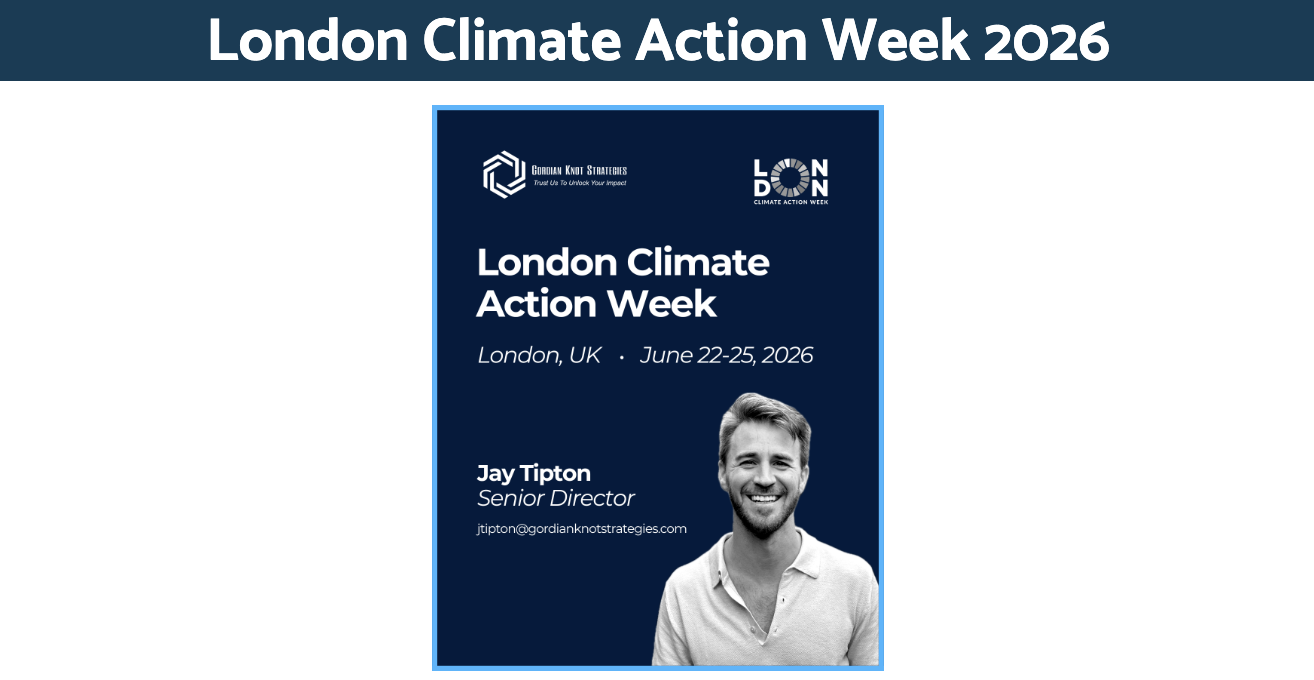
This June, Jay Tipton, Senior Director at Gordian Knot Strategies, will be representing GKS at London Climate Action Week (June 22–25). If you’re attending and would like to connect, reach out to Jay directly at jtipton@gordianknotstrategies.com – his calendar is filling up fast!

At Gordian Knot Strategies, our goal is to help mobilize $1 billion per year in climate finance. That is why we’re committed to making climate finance smarter and faster by addressing a broken impact investing screening process.
That’s why we built TRARO®, a predictive analytics platform designed to help investors rapidly triage opportunities with clarity, consistency, and confidence.
Have a climate project? Submit it to TRARO® for a free screening and based on assessment outcomes, we can match you with interested impact investors. You can also explore real-world case studies to see how TRARO® supports smarter investment decisions. You can find more information and how to create an account on TRARO® here.
Are you an impact investor or funder? Get in touch with the TRARO® team at traro@gordianknotstrategies.com to access scorecards from high scoring projects, or run targeted RFPs through TRARO® to streamline your process, save time, and reduce review costs.

We’re building a global database of impact investors to help mobilize $1 billion annually in climate finance by 2030. If your organization is interested in funding climate or environmental projects, we invite you to fill out our Impact Investor Information Form. Your contact details will remain confidential, and we’ll only connect you with aligned opportunities. There is no fee to participate.
To access the form click here.

Interested in connecting with us on climate finance, impact investment, climate solutions strategy, or carbon credit development and commercialization?
Book a 30-minute conversation with Gordian Knot Strategies here to discuss how we can support your goals.

Disclaimer: Hi there, you are receiving this update from Gordian Knot Strategies based on your previous engagement with us in some capacity. If you wish to unsubscribe, please use the link below, and we promise you that your contact details will be permanently removed from our distribution list. Thanks!
Want to unsubscribe?
Click here.
Want to receive the Sliced weekly dispatch?
Click here.
If you want to see more of our content, check out our monthly newsletter, Virtus.
Click here.


